Playing Solo Chapter 3: The First Five Minutes
Learn spawn logic, early routes, and how to survive the initial opening phase in Arena Breakout: Infinite (ABI).
The first few minutes of a raid are often the most unstable. Every player has just spawned, everyone is still close to their starting side of the map, and most people are moving with some kind of intention. Some are rushing loot. Some are pushing nearby spawns. Some are trying to reach a task location. Others are simply trying to get away from danger before the map becomes active.
For a solo player, this phase matters more than it may seem. A bad decision in the first minute can place you directly in the path of a squad before you have gathered any information. A careless sprint can reveal your position to a nearby spawn. A predictable route can put you in a fight you never needed to take.
The early raid is not always about moving as fast as possible. It is about surviving the moment when everyone’s position is still fresh, close, and dangerous.
Spawn Is Information
The raid begins before you take your first step. During the loading screen, you can already open your map and confirm where you are spawning. Use that moment to prepare your first decision before you gain full control of your character.
A solo player should not treat spawn as a random starting point. It is the first piece of information the game gives you. Your spawn tells you where you are, what areas are nearby, which routes are available, and which players may have spawned close enough to threaten you.
Your first thought should not be loot. It should be orientation. Where am I? What spawns could be near me? Which direction are players likely to move? What route would a squad take from their spawn? What route gives me information without forcing early contact?
This matters because early fights are often decided by spawn knowledge. Players who understand spawn logic can predict where danger may come from before they hear or see anyone. Players who do not understand it often sprint into another team and only realize the problem when the fight has already started.
You do not need to memorize every spawn perfectly at first, but you should gradually build a mental map of danger. After enough raids, you should know which spawns feel safe, which ones feel contested, and which ones require immediate caution.
The better you understand your spawn, the less random the beginning of the raid becomes.
The First Decision
After spawning, every solo player has to make a first decision: move, hold, rotate, or listen.
Moving immediately can be useful if your spawn is exposed or if you need to reach a safer position before nearby players arrive. Holding can be useful if you expect another team to cross your area early. Rotating can help you avoid predictable contact. Listening can give you the information needed to choose the correct route.
There is no single correct answer for every spawn. The correct decision depends on your location, loadout, objective, and risk tolerance.
If your kit is cheap and your goal is profit, avoiding early conflict may be the best choice. If your kit is built for PvP and you know nearby spawns are likely to move through your area, holding an early angle may be valuable. If you are in a bad spawn with limited cover, moving quickly to a stronger position may matter more than staying quiet.
The mistake is acting automatically.
Many players spawn and immediately run toward the same loot area every raid. That makes them easy to predict. Others freeze for too long and lose the opportunity to move before the map becomes active. A good solo player makes the first decision based on the situation, not habit.
- Where can nearby players reach before me?
- Where will the nearest squads probably move?
- Am I moving toward danger or away from it?
- Do I have the kit to fight early?
- What is my escape route if I make contact?
Early Routes and Predictability
Most maps have natural routes. Roads, paths, fences, walls, bridges, buildings, and terrain all guide player movement. These routes become common not because players are stupid, but because they are efficient.
The problem is that efficiency creates predictability.
A solo player should understand common routes, but should not blindly walk directly on them. The safest route is not always the shortest one, and the fastest route is not always the smartest one. Sometimes the best option is to move beside the common route rather than on it.
This allows you to use the route without becoming part of the route.
By staying slightly off the obvious path, you can watch movement, hear players passing, and decide whether to engage, avoid, or follow from a safer angle. You are close enough to benefit from the route’s direction, but not standing exactly where enemies expect contact.
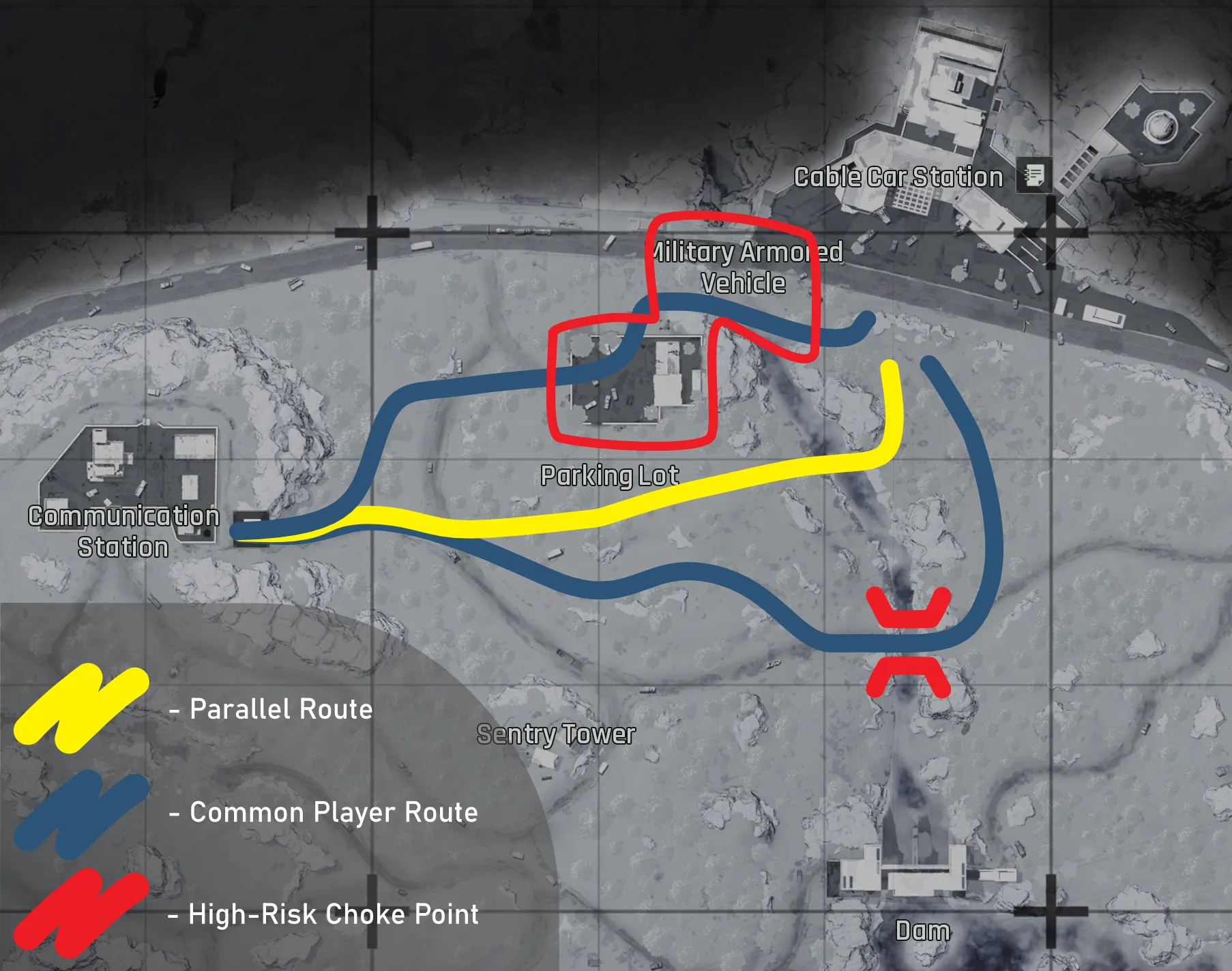
Example of parallel routing. The blue line shows a common player route, while the yellow line follows the same general direction from a less predictable position. The red marking shows a high-risk choke point where movement becomes predictable and escape options are limited.
This is especially useful early in the raid because many players move with momentum. They have a plan, they are trying to reach a location, and they often check the most obvious angles first. If you are not in the obvious angle, you are harder to read.
Do not confuse this with wandering randomly. Random movement is not a strategy. The goal is controlled unpredictability. You still move with purpose, but you avoid becoming easy to predict.
Objectives Versus Survival
At the start of a raid, players often become too attached to their objective. They want a specific loot room, task, route, or fight, and they force that plan even when the raid gives them warning signs.
This is dangerous for solos.
Your plan should guide you, not control you. If your intended route becomes active with gunfire, movement, or AI reactions, you need to reassess. If a squad reaches your target area before you, the correct decision may be to wait, rotate, or abandon the objective entirely. If your spawn makes the planned route unsafe, forcing it anyway is not discipline. It is stubbornness.
A solo player must be willing to change the raid plan early.
This does not mean giving up every time something becomes difficult. It means understanding that survival gives you more chances than one forced objective. A task can be completed in another raid. Loot can be found elsewhere. A fight can be taken later from a better position.
The first five minutes should be used to decide whether your original plan still makes sense.
If it does, continue.
If it does not, adapt before the raid punishes you.
Reading the Early Raid
The early raid has a rhythm. At first, players move from spawn. Then they begin entering points of interest, crossing major routes, fighting AI, opening containers, unlocking doors, or making contact with other teams.
Your job is to read that rhythm.
Gunfire early in the raid usually tells you where players moved from spawn. AI shooting or shouting can reveal that someone entered a nearby area. Distant automatic fire may mean a squad rushed to a hotspot. A single suppressed shot may mean someone is clearing quietly. Silence can mean an area is empty, but it can also mean players are moving carefully.
Every sound helps build the map in your head.
A solo player should constantly update their understanding of the raid. Where are players likely to be now? Which routes have probably been used? Which areas are active? Which areas may be temporarily empty? Which teams might rotate toward extraction later?
This is why spawn knowledge matters beyond the first minute. The map does not stay static, but the spawn layout gives you the first version of the raid. From there, every sound, shot, and movement updates that picture.
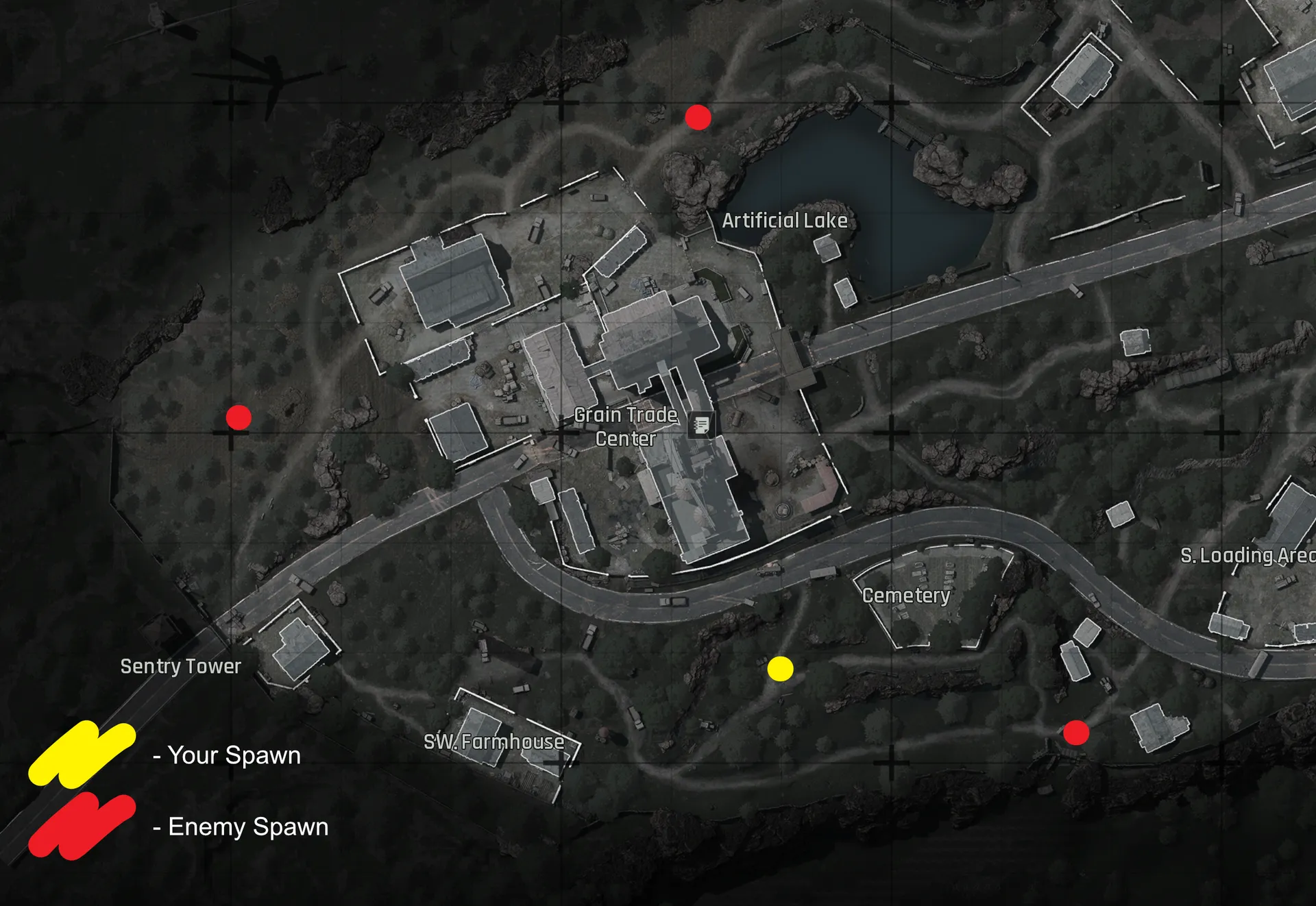
Complete Farm Spawn Distribution Map. Treat the map as a tool for understanding possible early threats, not as an exact prediction.
Note: These markers represent possible spawn locations, not all active spawns in a single raid. Real raids will usually use only some of them. Treat the map as a tool for understanding possible early threats, not as an exact prediction.
The goal is not to know everything. That is impossible. The goal is to know enough to make better decisions than players who are moving on autopilot.
When to Take Early Fights
Early fights are risky because the raid is still crowded and unstable. Other players are close enough to hear gunfire, and many squads have not yet committed to deeper routes. If you shoot early, you may win the first fight and still attract another team before you can heal, reload, or loot.
That does not mean early fights are always bad. Sometimes they are necessary. Sometimes they are profitable. Sometimes your spawn gives you a strong angle and the enemy gives you an easy opportunity.
The question is whether the fight gives you enough value to justify the attention it creates.
An early fight is more acceptable when you have a clean first shot, solid cover, an escape route, and a clear reason to engage. It becomes much worse when you are exposed, unsure of enemy numbers, far from cover, or using a loadout that does not match the range.
If you see a squad early and they do not know you exist, do not shoot just because you can. Observe first. Are they geared? Are they separated? Are they moving toward a building? Are they about to enter open ground? Is there another player behind them? Can your ammo actually deal with their armor?
Sometimes the correct play is to let them pass.
Letting a squad move ahead of you can be powerful. They may clear AI, reveal danger, start fights with other teams, or expose their route. If you follow at a safe distance, they become a source of information instead of an immediate threat.
A solo player does not need to be the first person to fight.
Often, the best solo player is the last person to commit.
Recovering From a Bad Spawn
Not every raid starts fairly. Sometimes you spawn close to danger. Sometimes your nearest route is exposed. Sometimes you hear movement almost immediately. Sometimes another team reaches a strong position before you do.
A bad spawn does not mean the raid is lost, but it does mean your first priority changes.
When the start is bad, survival comes before progress. Do not force your original plan. Do not sprint into the nearest objective because you feel behind. Do not take a fight just because enemies are close.
Your first job is to stabilize.
Stabilizing can mean moving to better cover, holding a quiet angle, letting a squad pass, rotating away from the obvious route, or waiting until nearby players reveal their direction. Once the immediate danger is understood, you can decide whether to continue the raid normally or change your plan entirely.
A common mistake is trying to “fix” a bad spawn by moving faster. Sometimes speed helps, but panic movement usually creates more problems. If you sprint without information, you may escape one danger and run directly into another.
Bad starts are solved by information first, movement second.
The First Five Minutes Set the Raid
The opening phase does not decide everything, but it shapes everything that follows. A smart start gives you information, space, and options. A careless start forces you into reaction, noise, and bad fights.
By the end of the first five minutes, you should have a basic understanding of the raid around you. You should know whether your route is safe enough to continue, whether nearby players are active, whether your objective is still realistic, and whether you should push, wait, rotate, or leave the area.
The best solo players are not always the fastest players. They are the players who understand when the raid is still forming and use that moment to place themselves correctly.
The first five minutes are not just the beginning. They are the foundation of the entire raid.
Keep Reading the Guide
Building a kit that supports your plan in Arena Breakout: Infinite (ABI). Learn the best utility baselines, weapon roles, ammo top-loading, stims, and armor options.
Next ChapterChapter 4: Movement, Positioning, and Information GatheringControlling what the enemy knows is how you win raids in Arena Breakout: Infinite (ABI). Learn proper noise control, visual vs solid cover, exit planning, and positional tactics.